Blog Image

Letters from 68 degrees, Kiruna

Blog at 68 degrees

What's happening here at 68 degrees, a bed and breakfast in Kiruna.

web page: www.68degrees.se

Bear Grylls in Kiruna

Here at 68 degrees Posted on Sun, December 06, 2015 17:46:44

‘Wilding’ is the new buzz word, I notice, in countries where there’s very little ‘wild’ left. In England there are people promoting schemes to ‘re-wild’ the countryside: introduce wild boar for instance, and allow vegetation to grow without check. ‘Wild’ hasn’t been a very positive word before in our culture – suggesting out of control and irresponsible – but now it’s attached to anything that people feel is a little bit outside the norm of behaviour, and it’s always used in a proud, to my mind slightly self-satisfied and smug, way.

Take ‘wild swimming’ for instance. When I first saw it I’d no idea what it was. I learned it meant swimming anywhere other than a public swimming pool. So what we did as children then, splashing around the surf next to our dissolving sandcastles, was really ‘wild swimming’. If my parents had known I’m sure they wouldn’t have allowed us to do it.

I’ve been swimming in lakes for years, but now I find that what I’m doing is classic ‘wild swimming’. I’m not sure how I feel about that. It doesn’t feel ‘wild’ to me – not in that out of control and irresponsible way, nor in a proud-to-be different kind of way. It’s just relaxing, convenient, cheap, and there are no dive-bombing kids to spoil your fun.

‘Wild’ is maybe only positive in a context where there isn’t any. In Kiruna it is certainly nothing to be proud of. That’s why people keep a very neat lawn in the short summer months – it’s your only opportunity to show that wild doesn’t rule your garden (an opportunity we ignore, by the way).

This week Rolf and I and some friends went out on a ‘wildlife safari’. Well it would have been called that if we’d gone with a tour company. As it was just us, though, we were enjoying a drive out of town and keeping an eye out for animals. We saw plenty of elk (moose), and reindeer foraging in the snow for moss, and a bushy red fox running through the snow, and all from the comfort of our warm car.
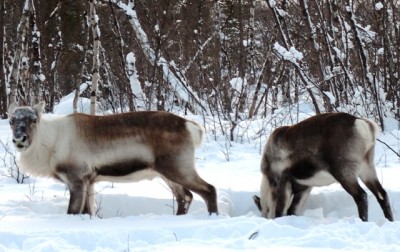

In a more populated landscape this kind of outing wouldn’t be given the ‘wild’ tag – we should at least have been in a jeep, and then had to protect ourselves from the animals in some way, maybe even stalk them for a few hours, possibly with a gun. No, this really was just a short drive before tea.

It’s confusing. The closer you come to really wild things and places, the less it looks or feels like a ‘wild’ activity – or at least, like one that someone in a less wild place would recognise. That’s why the tourist organisations here all indulge in a bit of storytelling when they take people out on tours. The tour guide turns up looking like Bear Grylls and tells tall hunting and survival tales about the potential dangers of getting lost in the wilderness, and you’ve no idea at the time that following his lead you’re actually driving round in circles only a few kilometres from where you started.

I was out running the other day and realised, as I negotiated the snow underfoot, that what I was probably indulging in was a bit of ‘wild running’. A tour company might market like this:

… Come fly with us! Feel the arctic wind in your hair as you run nimbly over snowdrifts, leaping among the lairs of the snow leopard, driving ever onward to the distant mountain tops in minus degrees of sub-zero temperatures far north of the arctic circle! If you’re lucky you may see the northern lights silently dancing over your head as you speed through the landscape! Wild running! You’ll never want to run on pavements again!..
Sakura of the north

Here at 68 degrees Posted on Sat, November 28, 2015 18:22:41

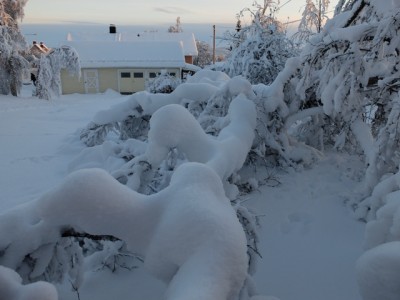
I like to watch snow settle. How it falls, spreads itself in wide hanging swathes on the top of balconies, sprinkles itself over a wire fence, sweeps along the ground in giant waves, hangs precariously from rooftops, drapes itself elegantly along branches, and, later, how it covers every single twig in a sparkling muffle of white, pulling branches into gentle curving structures that sway in the wind. We watch the snow fall, but then we have to decide where to remove it.

When we first moved here I was so excited looking out over the garden covered in snow. Just think, all this snow is ours! Our neighbour thought me very foolish, knowing the reality.Yes, ours, meaning that when it’s in the way you are responsible for moving it. At first I only wanted to remove the bare minimum, not even wanting to pile the snow up if it disturbed the look of smooth, untouched areas I admired from the house. But I’ve learned over time – three long, hard winters have made me a realist.

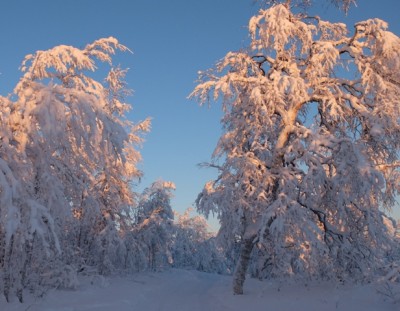
My particular favourite has been snow on trees, and, blissfully, there has been no reason to remove this. It hangs over us, at worst threatening a shower of cold snow from time to time when the wind blows, but otherwise obstructing nothing. Snow-covered trees against a blue sky are a thing of beauty. Even in the darkness of winter the moonlight makes the trees shine.

Snow on trees is a kind of sakura, a blossom that celebrates life. Like people in Japan admire cherry blossom, I’m drawn to looking at trees with hanging snow. Although there is nothing of the spring in them, there is something of the gloriousness of living. It’s hard to celebrate this with hanami, picnicking underneath the trees in company, drinking sake, gazing up through the white billowing branches at the blue sky – though the idea, in theory, appeals.

Like the cherry blossom, snow blossom is short-lived, which is a part of its appeal. It isn’t long before the wind blows it all away, or the temperature rises enough to disturb its grip. It inspires you to enjoy it while you can.

Not always though. This year we returned to trees bending heavily with snow, more than we’d ever seen. Birch trees up here are tough, and their ability to flex and bend help them to survive, but it was clear that such an abundance of sakura was just too much for some of them. Everywhere you could see trees that had broken in half with the weight, or lost their tops, or if already leaning they had broken at the roots as the snow pulled them over.

This is what happened to the birch trees in the middle of our garden. I’d thought the angle of them rather jaunty and characterful before, but jauntiness led to their demise. Elsewhere around our house trees were leaning over in a way that was pretty to look at, but to the tree was life-threatening.

I admired the sakura for just one day, knowing it wouldn’t last. This time it was me that broke the spell. I stood underneath a birch tree and looked up through the snow blossoms into the blue sky – did I really have to do this? But I had already reasoned that releasing them from this icy grip was a humane decision.

I began to hit a tree with a broom. I felt the eyes of passers-by swivelling in my direction – it was suspicious behaviour, I could see that. But I cared less about that than I did about the feeling that I was using violence against a thing of beauty. A mass of cold snow fell down the back of my neck in revenge. But then I felt the tree released from its burden, the thin branches begin to bounce back up to the sky.

Flushed with success I moved on to the next bent-over beauty, and the next. The more I whacked the birch trees, and the more the snow cascaded down, the more I enjoyed it. More and more trees returned to the sky. There are certainly some weird and wonderful ways to entertain yourself in Kiruna in November. ‘Tree-whacking’ – could it be the next big thing after dog-sledding?


Obstacle course

Here at 68 degrees Posted on Sat, November 28, 2015 12:29:41

We’d been away, off and on, for quite a few months. It wasn’t winter when we were last here, and now it was, so we were expecting a few obstacles in our way when we first arrived at the house. Primarily, snow in the way.

Snow in the way of reaching the front door. When we arrive from the deep south we are dressed for in and out of warm trains and airports and home in a taxi, not for digging a path to the front door in minus 14 degrees for half and hour. The first view from the taxi as it pulls up the end of Tvärgatan is full of hope. Has she? She has. Our dear neighbour, elderly and with mobility problems, has kept a path open for us. We could not be more grateful.

But as we reach the front door, which in our house is actually the back door, our optimism drains away as we look down over the garden and garage and see that our two large leaning birch trees have fallen. The weight of the snow, frozen on the branches, finally bent them too far. The trees narrowly missed the house as they fell, and for that we are grateful, but apart from our sadness at losing them it’s clear they now form a major obstacle. They are across our parking space, and – more worryingly – blocking one of our main routes for removing snow.

We get through the front door, turn off all the open taps and switch the water on, and look around for firewood. Did we remember to leave some ready cut? We did. The house takes 24 hours to warm up after this length of time, and the ‘kakelugn’ – a sort of firewood radiator – is a crucial part of the process. We’ll keep our coats and hats on for the next few hours at least, and we’ll have to keep physically active.

Not difficult. Snow in the way of the garage. It’s is a long way from the road to our garage, downhill, and our car is sitting down there, snug and dry, insulated by a warm pile of snow on all sides. We need a car here, running a bed and breakfast, and we need it soon. The first lot of shovelling is the hardest, because you have to turn around on the spot, trying to force through a space to take the snow. As you pivot round you eventually begin to free up the passage for snow, and soon – well, within a couple of hours anyway – you are actually managing to clear snow from the driveway.

A rough assessment of how long it will take – at this rate, given that there is the additional obstacle of fallen trees, with two people working shifts, and providing it doesn’t snow more in the meantime – is currently three days. Coffee breaks are required to keep the spirits up, but they are coffee breaks without cake, indeed without lunch, because there’s no food in the house. A trek through the snow brings bread (and other things) to the table and suddenly there is much to be cheerful about.

We do wonder why we came here, at this time of year, at our time of life, when the world has been made so easy by advancing technology and high standards of living. We could’ve been sat in a warm flat somewhere, further south (no snow, and if there was, someone else would be responsible and a machine would move it), easy public transport on our doorstep, no physical effort required. Everything could be done at the touch of a button, and instantly.

It was like that when we were in Stockholm. So easy. I read in the paper they were discussing putting in additional recreation facilities in the large open area nearby. Rows of raised objects at varying heights alongside the walking path. An obstacle course, for people wanting to get a bit of exercise as they pass through. You couldn’t make it up.


Year of the Lemming

Here at 68 degrees Posted on Wed, July 22, 2015 19:36:35

They’ve a really bad public image, lemmings. We’re led to believe they’re a weak-willed, lily-livered species, following each other blindly, jumping off cliffs when the going gets tough.

It’s a myth of course, the suicidal tendency. In fact they’re extremely tough. They only move in a great crowd when there are so many of them they have to move elsewhere for food. Otherwise they’re loners, making their own trail and finding their own food in a very harsh environment.

Come the winter they don’t lie down and go to sleep for six months. They’re awake and active, living in underground burrows, seeking out small shoots and seeds buried in the snow.

Wildlife in the sub-arctic all depend on lemmings for their survival. If they don’t eat lemmings themselves, they’ll be eating something that does. Although lemmings are the bottom of the food chain they refuse to be the underdog. They don’t sneak around in a camouflage of neutral grey and beige, making life hard for their predators. Instead they’re an easy target in their shining coat of black, white and brown patches – proud, it seems, to be a lemming.

This year’s been a good year for lemmings so they’ve been quite visible, even to us who aren’t on the look out for them. We see them scurrying ahead of us into a bush root or a small patch of snow.

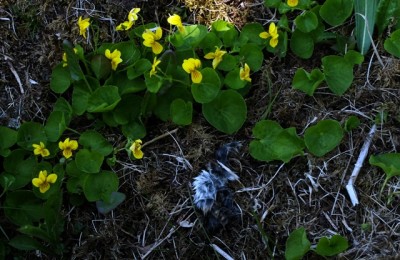
And when we come to rest somewhere for lunch, and we look down at the tiny dots of flowers down at our feet, we usually find among the pinks and greens a small patch of black, brown and white belonging to an ex-lemming.


A history written in the landscape

Here at 68 degrees Posted on Wed, July 08, 2015 13:51:34

I don’t know how we found ourselves there. We were exploring, and there were many old tracks to choose from. We didn’t climb any fences to get in, though we had to crawl under one to get out, so perhaps we weren’t supposed to be there.

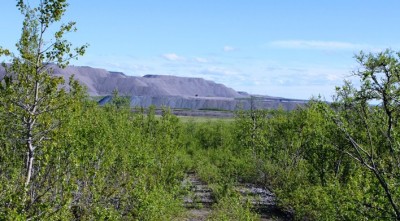
We were near Kiruna’s copper mine (currently resting, waiting for world copper prices to rise), around the side of Kiruna’s iron ore mine that isn’t visible from the town. We could see the mine’s iron pellets factory and processing plant, and all the well-concealed associated pollution.

A lot of the area is wetlands – some of it was once part of the lake but the mining company has drained most of it away because it lies on top of the mine.

There are no buildings, no people – it’s too wet, too polluted, too generally undesirable. Or maybe it’s just that there’s too good a view of the back of the mine. Now a wind farm sells the wind energy above it, and more than one mining company have the rights to what’s underneath it.

It has a different feel to emptiness in the fjäll. Here you don’t know what underground pollutants run through the streams or are embedded in the earth, yet wildlife know it as an undisturbed area where they can hunt and breed in peace. It reminded me of film I had seen of the Chernobyl area after the disaster.

As I stopped to take a picture I caught the fast movement of a creature, perhaps a fox. Its prey was probably an arctic hare that raced by, and then sat motionless on a rock. It was the largest hare we’d ever seen. A poisoned landscape is rich and plentiful and breeds super-animals.

The area is littered with empty roads that were clearly once in regular use. Their old speed restriction signs still stand at the roadside, advising passing wildlife to slow down. The roads connect with other dirt tracks and paths, and wide, winding old tracks which are probably even older, leading nowhere in particular.

We followed one of them as it snaked up the hill through birch forest. Buzzards flew and squeaked overhead, letting us know we were invading their territory. The road wound on, and on. We had to give up in the end. It seemed to be leading us further and further away, to no identifiable destination, which was both intriguing and worrying.

Later we looked on a map and guessed the road had probably led to a disused mine. It was just an empty road leading to a hole in the ground then. The repeating story of Kiruna, drawn in the landscape.


It’s hard to drive out of town

Here at 68 degrees Posted on Wed, July 08, 2015 13:47:11

As I’ve mentioned before, there are only four roads out of Kiruna and two of them are dead ends, one of which only goes round the corner. So there’s not much choice when you’re planning a day out. It’s right, left or straight on. After that it comes down to how far you want to drive before you get out and walk. It’s that simple.

Yesterday, reaching the junction at the end of the street, we looked at one another – right, left, or straight on? Right, we decided – we were in agreement (there’s a one in three chance after all). Towards Abisko then. We had a picnic with us, and our walking boots.

The drive along the fjäll road is part of the pleasure of such an outing – looking to the distant mountains, and at this time of year passing over fast rushing rivers. There are other cars and lorries, but they pass only occasionally so don’t interfere too much with your appreciation of the landscape.

We saw two reindeer by the roadside, with new springtime soft brown antlers. This is the time of year they should move up to higher ground to find new, mosquito-free grazing. We hoped these two strays would find their way to join their herd. It’s always a worry, seeing them so close to the road.

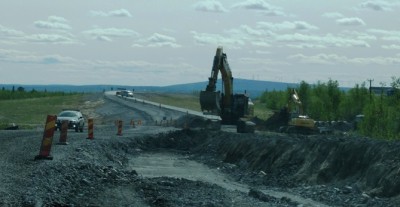
The winter had made large holes in the road surface, and as the we bounced along it seemed worse than usual. Then we noticed that ahead of us was a vehicle slicing off the top layer, in preparation for a new road surface. We’re grateful, in the long run, but while they’re doing it it’s hard to appreciate the gesture.

Our progress slowed to a very bumpy crawl. Every kilometre or so the road had obstacles on one side or the other – machinery, piles of rock, traffic cones. Sometimes there were traffic lights but sometimes not, so occasionally we found ourselves facing a lorry driving straight at us on the same side of the road.

Later, back home, we read that two motorbikes had collided with reindeer – probably the ones we’d seen. Perhaps frustration with their slow progress had led the motorbikes to speed up at the wrong moment. One of the men is seriously injured in hospital. Nothing was said about the reindeer, unquestionably dead.

The next day at the junction we both said, ‘straight on’. The dead end road to Nikklaluokta seemed a much calmer prospect than the road to Abisko.

And it was, at least for the first five minutes. Until we were directed onto another new, as yet unmade road, stones and dust flying ahead of us, digging machines ahead. It was another road of juddering and following slow digging machines. This new road will eventually replace the Nikkaluokta road, which, being close to the mine, is threatened like the rest of Kiruna. It isn’t a road yet though; it’s just pile of grit and stones.

It rather takes the shine off an outing, crawling along behind a jumping trail of cars. There are no other roads, so there aren’t any helpful long, winding diversions. We felt rather tired of roadworks, and yet at the same time we felt rather guilty about complaining. After all, if they don’t repair the roads we complain, and if they do…we complain.

So that was two out three roads we wouldn’t choose to drive down this week. What about ‘left’ then? Ah – well, this is the week that the immediate access to that particular escape road is completely shut off, due to pipe-laying activity for ‘the new Kiruna’.

It’s the start of the holiday season, everyone wants to get away to their summer houses, the tourists are arriving with their camper vans – it’s obviously the very best time for major roadworks.


Kiruna’s time to party

Here at 68 degrees Posted on Sun, June 28, 2015 14:52:16

Kiruna Festival – the last weekend in June – is when Kiruna’s distant and rather wild cousin comes to town. The Festival cousin likes a drink, loud music, and staying up late, and when she comes to visit, Kiruna remembers how to party.

The town centre is fenced off, a large canvas-covered bar and a full-sized stage erected on the main square, another stage built nearby, straddled across one of the main roads, and fairground rides and stalls fill the areas between. The town webcam is switched off, preventing outsiders from viewing the performances for free – but if you live in any of Kiruna’s central blocks of flats, experiencing Kiruna Festival is unavoidable.

I’d guess the town is divided in terms of whether that is a positive thing or not. Or maybe some of the older generation just feel squeezed out. The day before the Festival our neighbours’ houses become populated with young adults, their usual occupants having probably fled to distant summer houses for the weekend.

The Festival is designed to appeal to all ages – there are family-friendly events in the daytime, while the evenings are all about loud music and drinking. The town’s wild cousin is a party animal, and after a year of restraint Kiruna has a well-deserved weekend off.

It’s the only time in the year you’ll ever see police in town. Not that you see them doing anything much, but I read that one night they escorted some drunk young people home to their parents.

There’s a contradictory message being given out by the Festival, with its large area designed for consuming alcohol. It is the midsummer period, after all, and during these long summer nights some drinking and partying is to be expected. However, officials mingling among the festival-goers are there to challenge anyone that appears drunk and refuse them entrance to the bar areas. This is drinking in a very controlled environment – it’s drinking according to the Swedish principle of ‘lagom’ – not too much, not too little, just the right amount.

Try telling that to a teenager. Indeed, they don’t – instead there’s a system for teenagers to check-in to a tent before they go home to prove (to their parents) they haven’t consumed any alcohol at all. At least not on the Festival site.

The line-up for the Festival is mainly Swedish, but you won’t find many bands performing in anything other than English. They range in style from heavy metal, to rock, to pop, and the performers are both old pros from the 70s and up-coming young stars. The crowds are appreciative and responsive, and behave like festival go-ers everywhere, standing patiently shoulder to shoulder, waving arms and singing along to the encore.

This weekend our neighbour puts on his Elvis jacket and the 50s seem like only yesterday. All over town people are fine tuning their American classic cars for a cruise around town. If you don’t have a classic car, then any old banger will do, so long as you cruise. At two in the morning the clattering noise on the road outside our kitchen window is some youth cruising home from the Festival on their skateboards. Cars slow down around them, holding back patiently. There’s no sense of impatience. This is Kiruna’s wild weekend, and soon that distant cousin will be gone for another year.


Heavy Metal Road

Here at 68 degrees Posted on Thu, June 25, 2015 15:19:04

Every town has its suburbs, even small towns. The natural after-thought of the town when it’s already established, the suburbs are where people live in relative ease, away from busy roads or industry, getting on with their lives in relative peace and quiet.

In Kiruna the residential areas are as near shops and facilities as in the older part of town, but they have a different character. You see this in the street names. In the older town you move between streets named after political heroes of the 1920s (Adolf Hedin Road), mining heroes (Hjalmar Lundbohm Road, Hermelin Street), significant town activities of the early 1900s (Railway Street, Mine Road, Drillers Street, Drivers Street), important town buildings (Church Street, Library Street). Some streets in town still have no name – ours for instance (Crossing Street).

In the later, more clearly residential, developments the street names refer to natural phenomena (Aurora Road, Solar Wind Road), new activities (Satellite Road, Rocket Road, Radar Road), and features in the landscape (Birch Path, Forest Road, Rowan Square). These, more ‘suburban’ streets, follow a familiar pattern – they are named after the trees that were cut down to build them.

Perhaps it’s only when suburbs are built that people start see that development is about loss as well as gain, and feel the need to mark the lost land with a name that will always bring to mind what it used to be.

What to do, then, when you are relocating an existing town, as we are in Kiruna? Will this follow the pattern of early town behaviour – glorious heroes and worthy occupations – or the suburban model of marking natural phenomena and landscape?

It’s a question that has to be answered when it comes to building ‘the New Kiruna’. However, we’re a long way off that yet. The sign has been up for two years claiming the New Kiruna is being built, but still no new buildings to be seen.

To be fair, the council, responsible for the development, have had its problems with the chosen site. First there was an existing business there that refused to move until it was offered a reasonable relocation site. This matter went to various higher bodies to decide, and has only just been settled.

But after that came another problem. The site was partly owned by the mining company (LKAB) that had a mine nearby, now not in use. It turned out that the land was rather more poisoned by the presence of old metal compounds than anyone had anticipated. LKAB had pointed out to the council when the site was chosen that it was still in the area where iron ore existed, and they were not, for that reason, very keen on it as a site for the new town. But they were overruled (and one wonders if LKAB didn’t know just how poisoned the land was). Now there will be a process to remove these metal compounds from the land. We are assured this will solve the problem and the land will be fit to build on. The work will begin this summer.

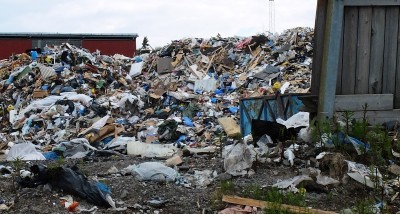
Meanwhile, it hasn’t gone unnoticed by the people of Kiruna that currently sitting right next to the site for the New Kiruna is a giant rubbish tip. A minor matter to move, you might think.

However, for some reason, since the site was chosen the council has failed to search for and apply for permission for a new rubbish tip site. Achieving this now will take some years. One can only wonder why this wasn’t thought of earlier.

But now, making the best of a bad situation, the council are applying for permission to keep the rubbish tip where it is. In the new town, they claim, things will be so advanced that chutes will bring rubbish directly to the site. Oh brave new world! How modern and admirable that will be! They won’t need to move the rubbish tip – we can instead all be glad it is so handily nearby. We’re not sure that the higher authorities, who must give permission, will agree with this vision, but at the moment it’s hard to see any alternative.

So we are trying to picture the future.

Should we imagine heading for the town hall in the new town’s central Copper Square? Going for a coffee in Oil Street, a short walk from the bank in Cobalt Park Avenue, and then returning to our flat in Heavy Metal Road? The supermarket might be in Mercury Street, and the town’s main hotel in Lead Lane. From there, visitors to the town might head out for a meal in one of the fine restaurants on Rubbish Tip Avenue.


Heavenly city

Here at 68 degrees Posted on Tue, June 23, 2015 15:11:05

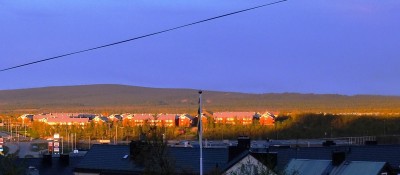
From ’68 degrees’ we have a view out over town, over the road to Narvik, to an edge of town development of housing – Lombolo – and, beyond that, to the hills, and the sky. Standing rather too proudly in the foreground, a flagpole erected by a nearby neighbour, flying the blue and yellow pennant, just in case we forget this is Sweden.

During these midsummer days when the sun shines in the night, it always shines on Lombolo, the buildings glowing orange against a backdrop of fresh green birch bushes. We are always reluctant to go to bed, seeing the distant sunshine.

Our house is in the lee of the hill that Kiruna is built on, and so at midnight the sun disappears behind it, which is indeed a blessing if you want some sleep. For most of Kiruna the sun at night is hidden by another hill – Luossavaara. It is part of the genius of the original town plan of 1910.

But we do like to see the midnight sun glistening on Lombolo. Even when the weather is cloudy, it seems to shine down there. As if Lombolo is the chosen one, the heavenly city of sunshine, floating on hills of green.

It must drive the people there nuts. Not only do they have to live with 24 hours of daylight, but their homes are sunniest at midnight. Perhaps there’s a topsy turvy world down there, people sleeping in the day and breakfasting at night. As we head off for bed, perhaps the people on the edge of Lombolo are out sunbathing on their balconies, sipping cool drinks through a straw.


Please don’t pick the flowers

Here at 68 degrees Posted on Mon, June 22, 2015 00:10:53

Midsummer day (taken as the Friday nearest the 21st of June) is big in Sweden. People get together, lavish meals are prepared, drinks drunk, photographs taken. You remember what you did last midsummer, and if you don’t, then you remember you drank too many schnapps. A proper midsummer celebration means a long light night, sitting outside, flowers in your hair, herring and schnapps.

Some people emailed us from England wanting to come to Kiruna this year to experience a typical Swedish midsummer celebration. They’d figured that as midsummer was about light nights, going where the night is as light as you can get must give you the most authentic experience.

I had to explain that they’d be better off going somewhere further south, where a bit of darkness increases the magic, and the climate brings something which actually looks like summer. Here it’s early days, the snow hasn’t completely gone, the flowers are mostly still under the earth, and we have so much light that, frankly, it’s hard to celebrate it – it doesn’t ever go away so you don’t really notice it’s there.

A little less light please, and then we could appreciate it.

However, I wanted, if possible, to have some kind of midsummer celebration this weekend. Elsewhere meadows are rich with colour and there’s plenty to choose from, but here there wasn’t a single wildflower to pick and the temperature wasn’t going to let us sit outside in the sunshine for herring and schnapps either.

It was clearly pointless trying to recreate a southern version of midsummer. So instead, we put on some warm clothes and went to the fjäll in search of – well, we weren’t really sure what. But I thought we should aim to adapt to what was on offer, rather than mourn the absence of what wasn’t.

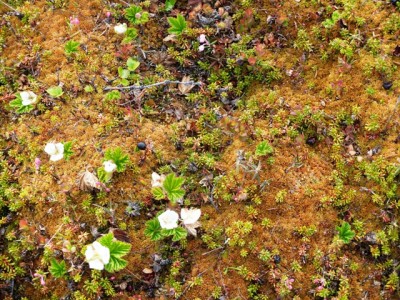
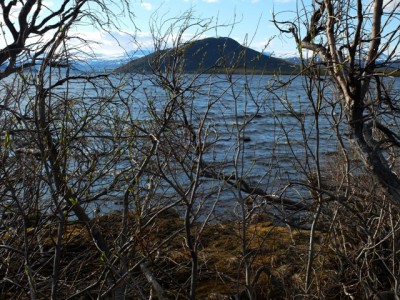
We stopped the car a short distance from Lake Torneträsk and wondered if the land next to it would be dry enough for us to walk on. Fortunately, it was, and before long we came to a huge area of brown and red, dotted with small white flowers. It was a rich area of moss, covered in cloudberry plants which had just produced tiny, fragile white flowers. This was a midsummer meadow, northern style.

These flowers were not for the picking though – if you picked one it fell apart in your hand. We were content to leave them where they were. The moss was resting on waterlogged land but was completely dry to walk on, and it sank under our feet like a luxurious pillow.

Down by the water, trees hugging the edge of the lake had spread their roots out horizontally along the surface, and grown low to be near the warmth and the moisture. They had adapted perfectly to the environment, and now that we had picked our way between them to sit on a rock, so had we.


No-Go Area

Here at 68 degrees Posted on Sun, June 14, 2015 23:34:29

It’s June, nearly midsummer, the sun is high in the sky and it’s there for 24 hours a day – but the air is cold, and the trees are only just beginning to sprout a light, vivid, spring green. It doesn’t feel right.

It takes a while to accept that this day goes on for a couple of months. The adult comfort blanket of day and night is removed and each day is weirdly unstructured. The result is strangely exhilarating.

The sun moves around above us in a circle, and the long hours of light are mesmerising. Sometimes I feel like a rabbit caught in the headlights – it’s a shock – what to do next, what to do first? I might want to do any number of things at any time of the day and night, and, alarmingly, I can.

It might sound rather stressful, all those options and opportunities for activity – but no. When you can do something at any time you find you can always do it later. These are perfect conditions for enjoying moments, or hours, of pure inactivity.

Sometimes the inactivity can be forced on you. Travelling along some parts of the trails in the mountains now you would find yourself ‘caught between a rock and a hard place’. The lakes are no longer ice but they are not yet water, so crossing them on foot or by boat is impossible – it’s a no-go area. Hikers are very disappointed to find they can’t walk from A to B as they’d planned. They are advised by local tourist and hiking organisations just to wander where they can, on circular day trips. It’s a lesson, surely.


The Brake Run

Here at 68 degrees Posted on Tue, May 05, 2015 17:59:30

If the seasons of Kiruna are like a giant rollercoaster – gathering speed, unexpected turns, lots of ups and downs – then after the vertical loops, interlocking pretzel turns, and zero-gravity rolls of the winter, in April we’ve finally reached The Brake Run.

The seasons have gone in a flash. Just as we understood what the conditions were, what clothes were needed, and what activities were possible, each season roared out of reach leaving us panting to catch up.

Spring-winter, the last season, we all love – ice lakes, warm sunshine in cold air, and lots of opportunities for skiing and picnicking on the lakes. Then around the start of April the temperatures begin to rise, the skies fill with humidity, and the big melt begins.

When the drip drip starts you can only sit indoors and watch the snow piles shrink. Cycling is possible, if you look out for ice on the path. There isn’t much to see – the days can be misty, the clouds hang low and grey, the snow is slushy or icy, depending on last night’s temperatures. You clear up the winter debris around the veranda. The outdoor Christmas lights are still trapped under the snow and you wait for the cables to reappear, their secret trails revealed beneath bushes along the house wall. You start thinking about the garden, wondering where you left the flower beds.

But spring isn’t a season to be hurried. The rollercoaster has temporarily lost its kinetic energy and is just trundling along the track. Its occupants are looking around them, taking stock, noticing nothing much is happening on this stretch, while still remembering the thrills behind. It’s The Brake Run.

The speed won’t pick up again until it’s reliably plus degrees 24 hours a day. When that happens it will also be light 24 hours a day and the season of spring-summer will do a hammerhead turn, a double dip and double up, and we’ll be hanging on again, breathless.

In the meantime it’s frustrating, watching the temperatures hover here, the wet snow fall, the grass refuse to peep through green.


« PreviousNext »