Blog Image

Letters from 68 degrees, Kiruna

Blog at 68 degrees

What's happening here at 68 degrees, a bed and breakfast in Kiruna.

web page: www.68degrees.se

Not the least bit SAD again

Here at 68 degrees Posted on Tue, December 12, 2017 16:44:15

While the rest of the world is worried about SAD (seasonal affective disorder), in Kiruna we are welcoming the arrival of the polar night.

From tomorrow there will be no daylight for about a month, and we really don’t care. I know this sounds terrible. You’d have to experience it to understand that it’s a gift. I’ll try and explain.

Imagine all the frantic rushing around of the season – all the worrying and business, all the feelings of trying to squash too much into too short a day – instantly calmed by the simple expedient of simply switching off the light.

Desperately-trying-to-make-the-most-of-the-short-day experience replaced by no day at all. All routines gone, the markers of day and night blurred so it no longer matters much which is which. So what’s your hurry?

Like someone’s put a black bag over your head to calm you down.

Meanwhile on the streets the darkness brings out a wild celebration of all things bright and beautiful. Flashing fairy lights across balconies, tumbling lines of colour baubles strung over gardens, illuminated plastic reindeer in front yards, lights tied to twigs in pots on the streets, illuminated flagpoles, and of course, lit-up Christmas trees plonked at quirky careless angles in the snow – because in Kiruna we don’t keep our Christmas lighting hidden indoors.

In the period of polar night we’re hunkering down indoors, indulging ourselves, doing exactly as we please, maybe with sweet saffron buns and spicy glögg. It’s a very special time, and no-one’s the least bit SAD.


Mysteries of the local planning office

Here at 68 degrees Posted on Thu, November 30, 2017 16:51:16

It feels bad to say it, but our conclusion is that perhaps local planning and building regulation is not a fair process. I hoped for better from Kiruna.

Here’s how it works.

We’ve run a bed and breakfast for six years in our home in a residential street. When we bought the property we didn’t make any alterations to the house because we have people to stay in our home just like any family members would. Before we started we checked all the rules and regulations. We registered for, and we pay the proper tax. We put a sign up outside. We’re all ‘above board’.

Six years later we were notified in the post that someone had anonymously reported us as operating a hotel without planning permission.

Excuse me, planning permission?

We were puzzled, and a bit disturbed. Still, we filled in all the forms as requested, describing what we’d been doing, and explaining that no part of our house had been changed.

Then followed an eight month silence, during which time we tried to find out whether there was some small print regulation we were offending against by mistake. We didn’t find anything, but were still worried. Were they going to shut us down? Should we cancel our bookings?

Then we got a letter saying that because we might be operating a hotel without planning permission someone was coming to inspect the property – in just four days’ time. Note the long notice.

We had no idea what they were coming to inspect, but we were there to invite two men from the planning department into our house and ask them what they wanted to see. They indicated the upstairs, so we followed them up. But upstairs they had no interest in looking at any of the rooms or any of the facilities. Instead, they leaned against the worktop and gave us a lecture on how we ought to have applied for planning permission when we first opened.

‘Planning permission for what?’ we asked, not unreasonably.
‘To run a bed and breakfast’, they said.
‘But what planning rule have we offended?’
‘Ah,’ they said, as if unwilling to reveal the secret mysteries of the planning department, ‘it’s very complicated – it isn’t clear.’

It isn’t clear??

Then they told us that a committee of local politicians (note, not council people paid to apply known regulations, but politicians who just have an opinion about it) would meet to discuss our case and decide if we had to pay a fine.

‘A fine? For what?’
‘For not following the rules’, they said.
The rules they couldn’t tell us about, because they’re not really clear. Oh, those rules.

There’s been this threat hanging over us for a year now, over nothing that anyone can explain to us. And they still haven’t written to tell us we needn’t worry as it was all some mistake, which we must assume to be the case.

Now, by way of comparison, let’s take another important matter that has passed through Kiruna’s planning department this year – the building of the new, year-round Ice Hotel, a large permanent building on the banks of the Torne river.

After it got planning permission and was built, some neighbours complained that the building was contrary to local planning regulations, and because the decision had already been made by Kiruna’s planning office local people appealed to a higher court. The higher court agreed with them and overruled Kiruna’s decisions. Now that would be something to worry about you’d think – a bit more of an issue than a two room bed and breakfast which didn’t build anything at all.

But no, not at all. The Ice Hotel isn’t the least bit worried, because, they say, smiling to the camera, the local planning department will just change the regulations, and then they won’t be breaking the rules any more. No mysteries there then. Problem sorted!


Kiruna’s kind of hero

Here at 68 degrees Posted on Tue, November 28, 2017 23:34:29

We’re standing at the edge of a pit in Kiruna. The town is falling into one, and we’re in danger of throwing away the only opportunity we have to replace it.

This is Kiruna’s hour of need. Not by any stretch of the imagination it’s ‘finest hour’ – though that’s the film chosen for our pre-Christmas film treat at the local cinema. In our wildest dreams we can’t imagine this is anything to be proud of, staring down into that pit, the wind whistling in our hair. There’s a deathly silence. What’s to happen to Kiruna?

The town is emptying as the mine buys up properties. With ample compensation offered it’s no surprise that both businesses and flat owners prefer the cash to the compromise – waiting for LKAB to build a replacement flat or shop for them somewhere in the new town.

In the new town there’s a town hall, and a road layout, and pipes laid out for services, but not a lot else. There’s still no sign of flats or houses, shops, restaurants, or hotels, indeed no sign of anything that might indicate this area might really become a town. There’s just that wind, whistling now around the old town hall clock, erected spookily in a big empty space next to the new town hall.

What Kiruna needs is a good old fashioned hero. Someone to ride into town, perhaps not ‘with all guns blazing’, but at least with a steely look in his or her eye, and probably a mighty fine horse. A hero to take this town on, to tell people they mean business, they can make it, a town with options, a town where people want to live. No-one knows how though, we just live in hope.

That’s surely where the competition, ‘Kiruna Inhabitant 2017’ comes in. It’s held every year, and, quite simply, people in Kiruna vote for the person they think has done the town most good. In the past we’ve had authors, social workers, business entrepreneurs, cultural administrators, shoe makers, rights campaigners, doctors, sports people and rock bands. When you go to your local corner shop you can stick in your vote, and then we all wait until January to find out who’s won.

This is where I get a bit confused. There are some worthy winners here in the short list of six but strangely, not one of them is doing anything to try and save Kiruna town. I wouldn’t expect any of them to throw themselves in front of the bulldozers, but it would be nice if this year’s town hero might be someone who was doing what they could to come up with clever ideas to attract people to set up business or life in the new town, or better still, to do it themselves. It’s a mighty task though, and for that we’d need a mighty hero.

Enter, Johan Lans and Johan Stålnacke, for instance. They’re very successful businessmen, and they run a popular hotel and an even more popular restaurant in town called ‘Spis’. Now we think ’68 degrees’ is without doubt the best place to stay, but when you want to eat the place in town to go is their restaurant at ‘Spis’, just a few minutes up the road from us. They are admirable local entrepreneurs.

And yet, what’s this? The shortlist says they are nominated not for their successful business but because, as the town begins to deteriorate and businesses leave, ‘Spis’ are still there, ‘keeping life going in the old city’. Not galloping into the new town on a wave of optimism and hope, but camped out in a beleaguered corner of the remaining town, hunkering down, waiting to see what happens.

Kiruna’s kind of heroes don’t blast their way into a new future – they stay put and make the best of things – at least until they’re forced to move on. And when that time comes, if ‘Spis’ moves to the new town, I’ll eat my hat.


Hard times ahead

Here at 68 degrees Posted on Mon, November 20, 2017 17:09:25

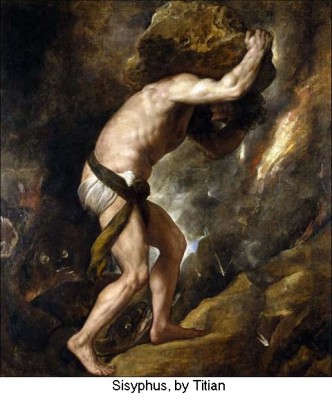
In Greek myth, Sisyphus was condemned to roll a large stone up a hill, perpetually. As soon as it reached the top the stone fell down and he had to start all over again. We know how he feels. We’ve been moving snow and then moving it again an hour later from the same place all morning. We’re condemned to be doing this for the next 24 hours, by the look of the latest forecast.

This is activity without results, like running on the spot. It takes all our energy to stay in the same place.

Camus famously argued that we should think of Sisyphus as happy. Sisyphus understood that the point was just to ‘be’, not to get anywhere, or achieve anything.

While moving our stone we have time to observe the world around. A hare on a pile of snow with beady black eyes, looks at me, unblinkingly. Perhaps I am shovelling to reveal some soft juicy hay? A flock of crows circle overhead, their dark shapes form patterns in the sky, black arrows and white specks of snow assemble like pieces in a giant mosaic. Birds gathering to eat the very last of the vegetation on top of tall trees. This season, mid-November, has the feel of hard times ahead.

All twigs on the trees are white and snow gathers along our window ledges and along the veranda outside the front door, sealing us in, wrapping us up. Daylight is leaving us at a rapid rate and will disappear altogether in two weeks’ time. There’s a rhythm to the time of year, it feels like sliding down chute at an accelerating speed. All we can do is abandon ourselves to the feeling; resistance is pointless. Actually, as the time of midwinter approaches it isn’t at all hard to think of ourselves as happy.


Watch this space

Here at 68 degrees Posted on Sat, November 18, 2017 10:34:41

It’s hard to know where to begin. We’ve been away the whole summer and autumn, which means that when we returned a few weeks ago, the town was different. We were prepared, we thought, for buildings and streets removed – the start of the mine clearing the part of the town nearest to the collapsing ground. We were prepared, we thought, for the loss of some of the town’s history, and even of our own, short, personal history here. We thought we were prepared for change but we weren’t really.

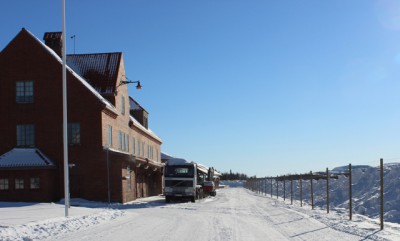
In the centre of town, nearest the mine, a whole row of grand buildings gone – the old brick station building, a couple of hotels, warehouses from the turn of the last century. Then a couple of streets nearby, where old wooden houses marked a route to the first mine director’s house, now ground with no particular purpose standing idly by.

There’s no trace of violence. You feel you’ve woken from a dream. Buildings, what buildings? You must be mistaken. See, just white snow and space. All calm. It’s unsettling, to say the least. Now you see them, now you don’t.

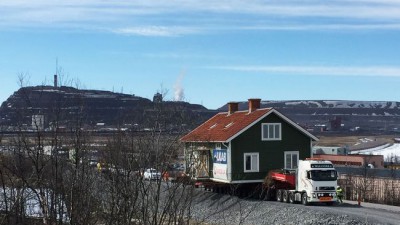
On the edge of town, below the ski slope and beneath Kiruna’s other, older mine, there has appeared, as if by a miracle, a small hamlet of wooden houses and buildings from the early 1900s, like a film set, brought on a lorry and plonked on the snow by the main road out of town. The first director’s house now stands proudly to one side, surveying the mine and all its magnificent works. The houses around stand blinking innocently at you, determined to look settled after their journey by road from one end of town to the other.

It’s not a film set, but it is a creation, a fictional Kiruna that we are led to believe was always here. The king is dead, long live the king!But wait a minute – this isn’t where they decided Kiruna’s new town should be – that’s far away on the other side of town!

Ah yes, Kiruna’s new town centre. The town hall is almost complete, and now the clock tower from the old town hall stands next to it. Plans for other buildings – flats, shops, offices – have all come to nothing. They’ve been much discussed, and thought of, but their presence here is only as ghosts of an idea and a promise not yet fulfilled.


Is it environmentally-friendly?

Here at 68 degrees Posted on Sun, April 16, 2017 23:40:16

Everyone’s aiming for environmentally-friendly tourism these days, and that includes Kiruna. But companies here think they’re doing it already because all the tours are – well, in the environment. And the best thing about this is that it’s now being suggested that these kind of tours should pay less tax.

So when people show up in Kiruna and are rushed out on their northern lights tour, they are, we’re told, being environmentally-friendly. They may choose to begin their tour with a snowmobile trip, sending pollutants in the air as they speed across the frozen river. Or they may have booked to ride behind meat-eating and carbon -producing dogs. Or maybe they’re just driven out to the aurora dome in a car.

Their guide is probably staying here temporarily, from Germany or France, but he’ll have a few stories to tell round the campfire. They’ll sit in something specially constructed for the purpose, for a few hours, and then they’ll be driven back to their hotel. Where they will have a very very long shower to warm themselves, after the cold wait for aurora. They’ll not be around in Kiruna for long – having to move on to the ice hotel, or their next stop – in Iceland perhaps, or London. They’ll have met quite a few other tourists, and got the photos they needed. They may even get the train back to Stockholm (environmentally-friendly) before boarding another flight to their next destination.

It’s sad that this kind of tourism doesn’t even seem to encourage any interest in the local environment. Experiences are delivered in largely artificial ways, often by people who haven’t lived here for very long, and the natural phenomena are packaged in or alongside something basically unnatural.

It doesn’t have to be like that, if we stop encouraging tourists to look for Disneyland and instead help them to see what’s actually here.

Like the annual ice fishing competition recently. A lot of people sitting on the lake in Kiruna in very cold conditions. They have to be three metres apart, so they’re each in their own space in the environment, but they may still manage a conversation with people nearby. Or they’re just sitting, thinking about the fish below the ice. Some of them are lying, their face in the hole, looking for passing fish to tempt with a titbit. Most don’t seem that bothered, though, whether they get a fish or not. They’re at peace with their surroundings.

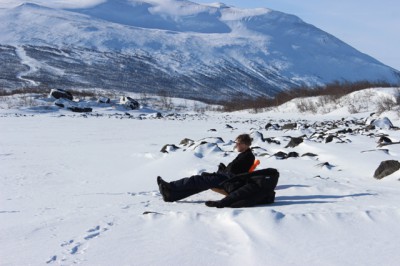
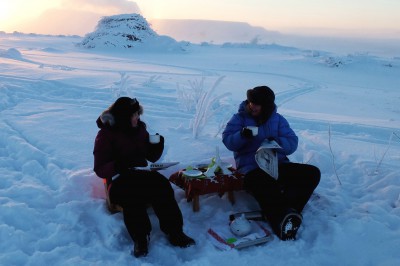
Every spring we take our small deckchairs out onto the ice on Lake Torneträsk, walking across to a distant spot. The ice is metres thick, and the snow ripples across it where it’s been blown by the wind. We put the chairs on the ice, and sit there. For as long as we can. It’s mostly quiet. We drink coffee. We may call greetings to someone setting up his ice fishing hole nearby. We’ll probably take a walk further across the ice, enjoying the space, the colours, the sensations. Just looking at the landscape, and listening. It’s ice fishing, without killing a fish. It’s as environmentally-friendly, perhaps, as we can get.


Wanted: Mystic Meg in Kiruna

Here at 68 degrees Posted on Sun, March 26, 2017 14:23:05

Last night I took out my crystal ball. I wasn’t sure it was still working, but I gave it a good scrub and then a billowing mist spread around the ball. I waited patiently for the mist to clear.

I was wondering what the future holds for the town of Kiruna. That it will slowly disappear into a mining pit is not in doubt, but what will emerge in its place is the question.

Over the last few years, since we all knew the town would have to move, we’ve listened to all kinds of consultants brought in by the local council to ‘have ideas’ on our behalf. It hasn’t been easy. There was the ‘Kiruna 4 ever’ phase for instance, when I felt like we were back in primary school, playing with our crayons to draw our way out of the problem. That wasn’t far from the truth – the local council did ask local schoolchildren to come up with some ideas. These, as it turned out, were a lot more sensible than the ones the consultants came up with. Flying gondola transport, huge outdoor bubble pools, and a giant tropical greenhouse – it was hard to keep a grip on reality.

Architects from anywhere far enough way to have no experience at all of what it is like to live here – Norway, Denmark, the far south of Sweden (where is Malmö, exactly?) – were invited to take part in a competition by submitting a plan for the new town. In their architectural design plans we saw ourselves depicted, calmly chatting to one another in the new town square in minus 30 degrees, having arrived there from our nearby flats on our skis, warming our hands round the town (architect-designed) brazier. We were a people, apparently, ill-adapted to walking (hence the skis) but well adapted to temperature (hence the standing around getting cold chatting rather than diving into a nearby shop or cafe). We’ve known it was all a huge distraction, so we’ve been holding our collective breath, waiting for the mist to clear so we could see the real picture. We’ve gone red in the face now, it’s been so long.

The first thing that happened was that last year they started building the new town hall and laying the road infrastructure in the area to be the new town centre. I saw the pipes going into the roads today, the pipes to serve all the buildings that are expected to appear. Only, no-one seems to want to build there. The costs are too high, there’s nobody there, there’s no reason for anyone to move there so there’s no reason for anyone to invest money to build anything. There’s a rubbish tip right next to the site, and they haven’t even found a place to move it to.

Kiruna is hanging out with mates on one of the old street corners, whistling quietly to itself, looking in the other direction. It’s a bit embarrassing, all this new town centre lark.

Meanwhile LKAB (the mining company) is negotiating individually with flat owners, businesses and shops that will have to move. The rest of us are watching, nervously, and it’s more entertaining than ‘Melodifestivalen’ (selecting the Swedish entry for the Eurovision Song Contest). In this popular game show (called, ‘The Price is Right!’) contestants are given a choice: they can either choose replacement premises, in an empty undeveloped area where no-one else in town has moved yet, for an undisclosed rent (but definitely a lot higher than they currently pay); or they can choose a sum of money as compensation. It’s no surprise that every time the audience screams ‘Take the money! Take the money!’. And they do.

This, you may appreciate, isn’t helping the local council make their dreams of a new town come true. No-one is committing themselves to the new town, so builders and property management companies have no reassurance that if they build there anyone will actually choose to move there. You’d have thought the local council could have predicted this problem – and worked out a way of attracting people to committing themselves early on – but they don’t seem to have had a functioning crystal ball. Pity.

In their crystal ball they might also have seen the rival shopping and business area developing in another part of town. They might have seen the large rental units being built and the shops moving there and they might have realised, this needs to be stopped! These businesses have to be persuaded to move to the new town centre instead!

Too late! It’s already happened! The Coop Forum shopping area is ugly, functional, and full of people. Right next to it is Lombolo, Kiruna’s largest suburb – a quiet area of curving streets on the edge of town, now very well placed for access to the best place to shop. The Coop Forum area has a large food supermarket, electronic gadgets and equipment, high street fashion, building materials and pet supplies. Single retired men, who’ve spent their lives working for the mine, like to hang out in the burger bar for hours and watch the world go by. Someone sells lottery tickets for the local Lions Club in the main supermarket entrance. Youth hang around the car park looking cool. It even has street beggars. Sounds like a town centre? Well yes, but not the kind imagined by those clever architects, clearly – there’s no-one here languishing idly against a fancy brazier in a pair of skis – but to us, well, we think we could do worse.

From the Coop Forum car park we look nervously over our shoulder towards the ‘new town centre’, where snow blows aimlessly over ground that is not looking like it’s going to be a town or a shopping centre anytime soon.

Rubbing their crystal ball one more time, and this time looking in another direction entirely, the council might have seen something even more worrying and threatening. On the horizon, to the north west of town, on the slopes of Luossavaara, where LKAB have always wanted the new town to be (because there’s no iron ore there) there is building work going on. A lot of building work actually. This year, contrary to what was originally planned, some of Kiruna’s historic old buildings will be moved there. They had been planned for the new town in the early days, but something changed. So now, they will go far away to the other end of town. LKAB is responsible for them – it owns them – so it is moving them. LKAB is also building some fine new flats there. Many of their own tenants will be offered one of these flats, near the old town centre, with mountain views, in an area where people already live. It won’t be a difficult choice for people to make – a flat here, or a flat which may or may not be built next to the new town hall somewhere that is currently not part of a town.

I think the council have been rather negligent, not keeping their crystal ball in proper working order. They’ve had a lot of meetings, and paid an awful lot of consultants, but none of them it seems thought to consult a crystal ball. Pity.

I’m shaking mine rather fiercely now, trying to tune in to 20 years’ time. Eventually the haze disappears and out pops a clear picture.

It’s the new town centre – I know that because on my extra high-spec ball I get smells as well, and I get a whiff from the rubbish dump there – they obviously never found a place to move it to. Anyway, I can see some buildings – there stands the new town hall – it looks very nice and round – and nearby is a swimming pool and a sports centre. At more of a distance I can see a school. Along the road, in the old cemetery, stands an odd looking building – a sort of modern brick block with a tent shape on the top. It’s Kiruna’s church (I guess it turned out to be too difficult, after all, to move the old one). The streets are named, but there aren’t any buildings on them – just some cars parked, perhaps people coming here for a swim, to collect children from school, or maybe to pick a fight with a politician in the town hall. A local bus swings past, empty. No-one stands near the (architect-designed) brazier in the main town square. Street lamps shed light on piles of snow which hasn’t been cleared away – I suppose since no-one lives here there’s no real need. Still, the kids coming out of the swimming pool are having fun throwing themselves around in it, before getting back on the bus which takes them to the other side of town.

If I shake the ball again, and concentrate really hard I can follow the road away from the ‘town centre’ to the Coop Forum shopping centre. Yes, there it is, lots of large retail units and a full car park, and the nearby suburb of Lombolo has grown too.

The crystal ball picture fades, and then shows a strip of old streets and houses – we live here – connecting this area to the other side of town, like a bridge. On both sides of this street I can see mining activity. On one side is a huge pit, where the old town used to be, and on the other side is the new mine (Lappmalmen). Doesn’t look like these streets will last for very much longer.

This image is then replaced by another – streets in the north west part of town, the slopes of Luossavaara. It’s quite tightly packed here now – I see the old buildings that were moved here – there’s some of the old ‘inkpot’ style houses, and the mine’s original hotel building, and the home of the first director of the mine. Continuing on from the residential streets that used to be here there’s now a whole new area of flats and houses, shops, cafes and restaurants, clustered together in the small spaces available on either side of the new main road out of town. Above them the downhill ski slopes operates as before, and is now supplemented with cross country ski tracks and snow scooter tracks on either side.

At the bottom of Luossavaara stands the ‘temporary’ railway station, now a permanent one because it’s so useful for bringing people to Luossavaara. ‘Welcome to the town of three parts’, says a sign outside.

I think I’ll have to lend my crystal ball to the local council, if it’s not already too late.
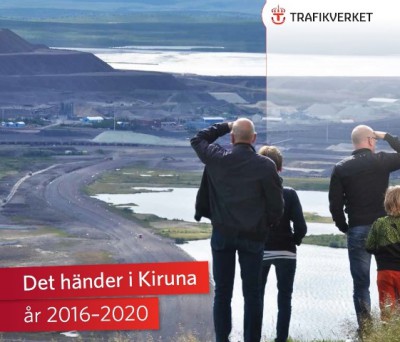
Trafikverket is responsible for building Kiruna’s new main road. Their leaflet – ‘It’s happening in Kiruna’ – seems to show people confused about where exactly the town is.

See my previous entry, ‘Looking for the lentils’, 2015:

http://www.blog.68degrees.se/#post120


Just don’t go there

Here at 68 degrees Posted on Wed, March 08, 2017 16:24:42

It’s school holidays in Kiruna – ‘Sportlov’, the winter sporting week – and the weather is winter-glorious. Most of Kiruna is out in the fjäll, or, if not, out in the landscape of Kiruna, sledding down the snow-covered old pits, skiing across the lake, making food over open fires in windshelters by the roadside. We were tempted out yesterday, but recent colds made us unfit for lengthy exposure and we couldn’t find an available windshelter that wasn’t full of smoke. That left us driving around town, looking for a sheltered place to sit.

We were looking for a sheltering building where we might be able to avoid people cooking sausages and enjoying themselves (which is all well and good in theory but sometimes you just want some peace and quiet). We wanted an unpopular, abandoned sort of place, but in town. Then we thought of Kiruna station. The old building, already out of use and due to be knocked down sometime this year, according to the mining company, LKAB. The godfather had spoken and the building was going to be taken out. It was a good thought to make use of it while we still could.

When we got to the station there was a lorry, men in fluorescent jackets, and – running along the old rail track – a new fence, separating the station from the mine, with a pile of snow stacked up behind it. Beside it, the path I liked to run along had become a dead end.

The men in fluorescent jackets eyed us uneasily. Clearly this wasn’t going to be a very relaxing place to sit in the sunshine. It was the beginning of the end for the railway station, and the work had begun, we noted, when Kiruna was on holiday.

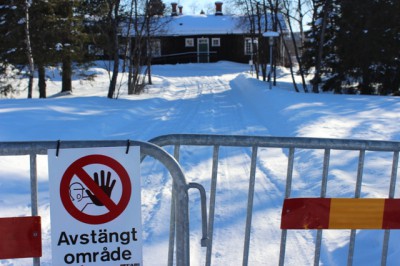
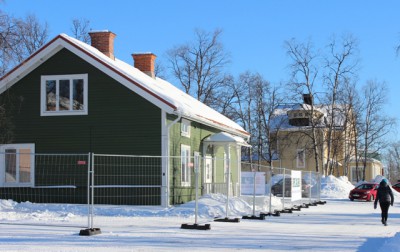
The story continued all over town. Diggers, mysteriously digging by the roadside; heavy wire fencing stacked up next to buildings; old houses enclosed behind fencing and locked gates; signs warning us to ‘Keep Out’. It was the day that LKAB began removing some of Kiruna, and the first time we had experienced what it would be like to live with fenced-off, no-go areas in the middle of town. It felt a bit creepy.

In the town’s ‘mine park’, already defined by LKAB as a ‘moving oasis’ – where a park would replace the buildings moved elsewhere or knocked down – the giant photos of some of Kiruna’s first inhabitants stared blankly out at the newly fenced-off areas, their stares seeming more knowing than before. Nothing stays the same. Despite all the razzmatazz about the current plan to move the town, this has all happened before. A whole community disappeared just behind here – streets, houses, roads, shops, businesses, childhood memories. This is how it is Kiruna; you move on.

As an exercise in change management it can’t be faulted. You tell people what you are going to do, you give them some time to plan their response, and then, one day, you do it. You don’t slowly let things deteriorate. You don’t pull a tooth, one by one, increasing the agony with cruel anticipation. You plan the destruction, and then you destroy. And, it isn’t a bad idea to start when people’s attention is elsewhere, and then there it will be, a done deed, no going back.

When things in your past stand in the way of where you want to go, you have to cut yourself off from them. Just don’t go there. I’m trying to see it that way – that there’s no point lingering where you no longer have a life. It’s cruel, the destruction of the town, but there are things to be learned from it.


Keeping up with the Kirunadashians

Here at 68 degrees Posted on Fri, February 24, 2017 18:43:14

We’re surprised that Kiruna is a common stop on the modern equivalent of the 19th century ‘Grand European Tour’. This tour is now a loop around Athens, Rome, Prague, Munich, Geneva, Paris, Kiruna, London, and Reykjavik. It’s a circuit featuring famous and fashionable cities, with historic buildings, art galleries, and shopping – and Kiruna and Reykjavik.

It may look a bit odd to traditionalists, but to the modern day traveller, usually coming from the Far East, a shooting geyser, a polar bear, and the northern lights are just as important for the Instagram account as all the other famous stuff.

It’s opened up Kiruna to another kind of tourism, one connected with high fashion, glamour photography, and gourmet food. Kiruna can provide the gourmet food, but the rest – I’m not sure we’re really ready for it yet.

I see, though, that Icelanders have their finger on the pulse as usual. ‘Keeping up with Kattarshiuns’, the latest Icelandic reality TV show, features a number of charming cats and kittens, left to roam, play and sleep in a specially-made cat studio. They purr, they settle, they lick themselves, just like ‘Keeping up with the Kardashians’, only feline – really.

And what does Kiruna have to do to keep up? It’s obvious isn’t it? The beaches of California are replaced with the low snow-covered hills of Kiruna, jungle-print bikinis swopped for full-body insulating overalls (in sexy pink, of course), the L.A. poolside penthouse estate swopped for luxury wooden kennels down by the Torne River. But the core ingredient is the same – daily gossip still centres around who is ‘Leader of the Pack’.

We’ve already begun filming, so here’s a quick preview. The show features dogs bred for action and fun, with pedigree backgrounds, an extravagant lifestyle, and a strong desire to be on TV. They are Spicy, Pitzy, Ratz, Mickey, Suzie, Petra, Aurora and Ice.

Spicy is a leader, and part of the team that competed and won the Yukon race last year. He gets to hang out a lot with the snow scooters, barking orders at the other dogs. They don’t mind though because he’s the King around here.

The first few episodes give you an insight into the dogs’ everyday lives. Ratz is off his food at the moment – the others are worried about him. In this week’s episode they come round for a supportive lick, and try and tempt him with some reindeer morsels.

Spicy’s eldest son, Pitzy, is a dog with attitude – we love it. In the current episode he’s mooning over Susie, bought in from a nearby kennel, a pure pedigree husky with long lanky legs and the perfect body. Suzie and Pitzy are planning a litter of puppies together this year. They get to hang out a lot in the doghouse, sniffing something. It’s cool (well, minus 18 at least). Later in the series we see their ‘Puppy Shower’, when the other guys come round with presents.

In a recent episode, Aurora and Ice are hosting an ‘At Home’ in their newly furbished kennels, when, after the guests have all arrived, they get into a terrible fight. Ice ends up bloodied. Later, the rest of the family are worried about him and try and get him to come out, but he just wants to stay in the kennels eating elk burgers and watching old DVDs of ‘The Dog Whisperer’.

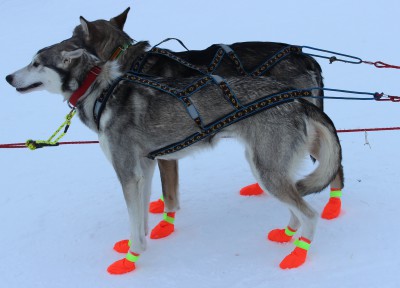
You should see Ratz’s fur coat – it’s sleek and gorgeous. He has to have it dressed and conditioned twice a week – that’s when it’s time to catch up on the gossip in the local furdressers. While we listen in we get to find out what Petra thinks of Pitzy’s latest enterprise, a showcase for edgy new fashion in the sled dog world. They’ll all be wearing purple bootees this season, apparently.

Coming soon, on the Arctic Channel, ‘Keeping up with the Kirundashians’ – don’t miss it.


In which the author explains why she hopes spring is not just around the corner, but looks for signs of it to please her friends

Here at 68 degrees Posted on Thu, January 26, 2017 17:52:47

Winter is bliss in Kiruna. However, many people in other, warmer, places, think I’ll be cheered up by signs of spring and keep telling me it’s just round the corner. They enthuse over early spring bulbs and the warmth in the sunshine, and then, feeling a bit sorry for me, make sympathetic noises and reassure me it won’t be long until spring arrives. They think I must feel very, very depressed, being still in the grip of deepest winter.

Personally I hope it will be a very long time before spring arrives, but I’ve decided to look for some signs of it now, just so as not to disappoint people.

This is what I found:

Street lamps. That’s the first sign of the spring. The street lights are now off in the middle of the day. Once there was darkness, now there is light – actually five hours of daylight, compared with none at all just a month ago. The light returns at the rate of ten minutes everyday. Phew.

Birds. Summers are short and they have to make the most of it. So even though it’s only January, the tits have noticed that daylight has flooded back and are singing loudly to mark out their sparse, snowy territories.

Picnics. We can have them. It may be cold, but at least there’s light.

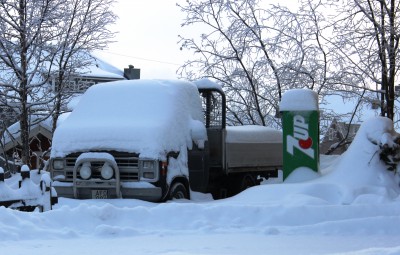
False optimism. Our neighbour has already installed a soft drinks machine in the garden in anticipation of the long spring and summer days. They can’t use it yet, but we like to look at it.

Big trucks. Roundabout this time the snow piles up in the streets so high that it has to be removed by big trucks and taken away to the humungous snow pile on the edge of town. When the snow is removed you can see the tarmac of the pavements again. This isn’t necessarily an advantage – it will be much more slippery than the layer of snow was – but it is, surely, a sign of spring.

Discarded ice cream wrappers. I saw one this month, weighed down by a pile of snow. On the other hand I saw one in December too, so perhaps a false sign.

Outdoor festivals. There’s one this weekend actually. OK, it’s name isn’t very spring-like (‘Snow festival’), but we get to hang around on street corners and eat reindeer burgers.

Christmas lights. A few people have removed them – a sure sign spring is on the way.

Later (over the next few months) the following signs of spring will appear:

Rautas premier. The start of the ice fishing season in the Rautas river. Maggots are in huge demand and the town is empty.

Hares. They’ll change from white to dappled brown and grey to match the ground in spring. They usually change in advance of the snow melting so become very visible.

Snow melting. Wet slush everywhere. Masses of ugly, grey grit on pavements to stop us sliding all over the place.

Light. Infuriatingly huge amounts of it. Hardly any time for sleep.

There now. Does that sound more cheerful?

I thought not.


Smooth as silk

Here at 68 degrees Posted on Sun, January 22, 2017 23:40:41

Kiruna’s Snow Festival – if you search for it you can read about the winter wonderland and the fun to be had at the festival. The winter and wonderland bit are true of course.

I wouldn’t want to run it down. The reindeer rides look fun, and every year the snow sculpting competition results in some weird and wonderful works of art, as well as some clumpy, uninteresting blocks of hacked-at snow.

If you’re into snowboarding you can catch some fancy footwork displays, and if you’re into snow scooters you can admire the ones lined up in the town square. You can get a burger from ‘Empes’ (always a pleasure, even if, like me, you don’t actually want to eat the burger) and you can watch the children larking around in the snow maze playground below town.

Then, the highlight of the occasion, you can watch the snow clearing competition – machine pitted against machine, 30 cms of snow moved in an hour – it’s a tense but exciting battle. It’s fun for all the family, as they say, at Kiruna Snow Festival.

Still, despite all these activities, at the end of the day – and the end comes fairly quickly at this time of year – the festival is a winner because of its main ingredient, snow.

I noticed today, clearing snow from the driveway in our garden, that the snow coming down is the best, most beautiful, most luxurious snow we’ve had all winter. It’s soft, it’s light, it’s smooth. As you push a sled it ripples ahead of you like moving water, and then it settles again in mounds like whipped cream.

It’s the Snow Festival and the organisers have specially ordered snow that feels like silk pyjamas.


Nah

Here at 68 degrees Posted on Thu, January 19, 2017 19:13:44

One of the things about running a b and b is that you come across all kinds of people. Now and again I’m reminded that some people’s lives and circumstances are really, really tough.

Take Susannah and Robert (not their real names), for instance. They’re from a continent far away – let’s not say which – and times are so tough for them that they have decided (they tell us) to ‘take a working holiday’. Now to you and me that might sound like a lot of fun – work, that’s a holiday? What could be better! But no, in this (and many other cases) ‘working holiday’ means impoverishment and hardship. Really.

True, they’ve had to spend a lot of money on their airfare to get over to Scandinavia in the first place, and also to fund their tour of Europe. (They’ve come all this way,- they can’t not see the Eiffel Tower!). They’ve been to Berlin, Paris, Zurich, Venice, Stockholm, Copenhagen. It’s been really hard. They’ve been jet-lagged. They’ve been moving on every few days. They’ve had to pay for ALL their meals.

Anyway, I digress a bit, because here they are now, writing to us about staying in 68 degrees bed and breakfast for a couple of nights. The thing is, they say, our rates are ‘way too high’ for them, but still they’d really, really love to stay with us. They’re students, on a working holiday, so, they suggest, maybe they could stay with us in a smaller room, or sleep on our couch – perhaps in return for a bit of ‘help’ in our backyard (though they’re understandably unclear what sort of help we might be in need of).

I’m a bit resistant to Susannah and Robert, at first. I don’t think our rates are high, given that we provide very comfortable spacious accommodation, a good breakfast, and lots of friendly help and advice. But then I have to check myself. It’s a good idea to put yourself in other people’s shoes before you judge them.

You see, Lynne, I say to myself, you have to remember the particular circumstances. When Susannah and Robert come all the way to Kiruna, like many poor students before them, they’ll have to go on a northern lights trip. And that’s not cheap. It costs double our nightly rate, just to sit outside in the dark for three hours in some loaned warm overalls, hoping the northern lights appear. But it has to be done, and, obviously, they can’t ask a tour company for a reduced price.

Then they’ll also have to go on a husky dog tour (you can’t come to the arctic and not have pictures of yourself with huskies!). That’s going to cost three times our nightly rate – for a three hour tour, going round in circles in the forest – and they can hardly ask the dog sled company for a free ride! The dogs have to eat, after all, and Bear Grylls – that’s the charismatic tour leader that’ll be taking them out – he has to eat and keep himself stocked in mountain jackets and survival trousers.

Then there’s Susannah and Robert’s meal out in ‘Spis’ – they’ve read on Trip Advisor that the special six course local specialities platter has to be experienced. They can hardly go to a nice restaurant like that and offer to do the washing-up! So that’ll cost them too.

Then there’s the entrance fee to the Ice Hotel, the souvenir champagne glasses from the Ice Hotel shop, and the pair of all-singing all-dancing Tecnopro Capri Pink Thermal Leggings they’ll have to buy (because it’s damned cold up here and they didn’t bring enough clothing). Shops won’t offer them a reduction, and they can’t very well ask for one without being seen as scrounging beggars.

No, the only way Susannah and Robert are going to be able to manage their budget on their trip to Kiruna is to ask us, very nicely, and with as sweet a smile as they can muster, if we’ll reduce our rates or let them stay for free. You can see their problem.


« PreviousNext »